Alabama attorney general: Courts are no place to defend state constitution
The AG's Office doesn't believe Alabama courts should hear challenges regarding the constitutional requirements for running for elected office.
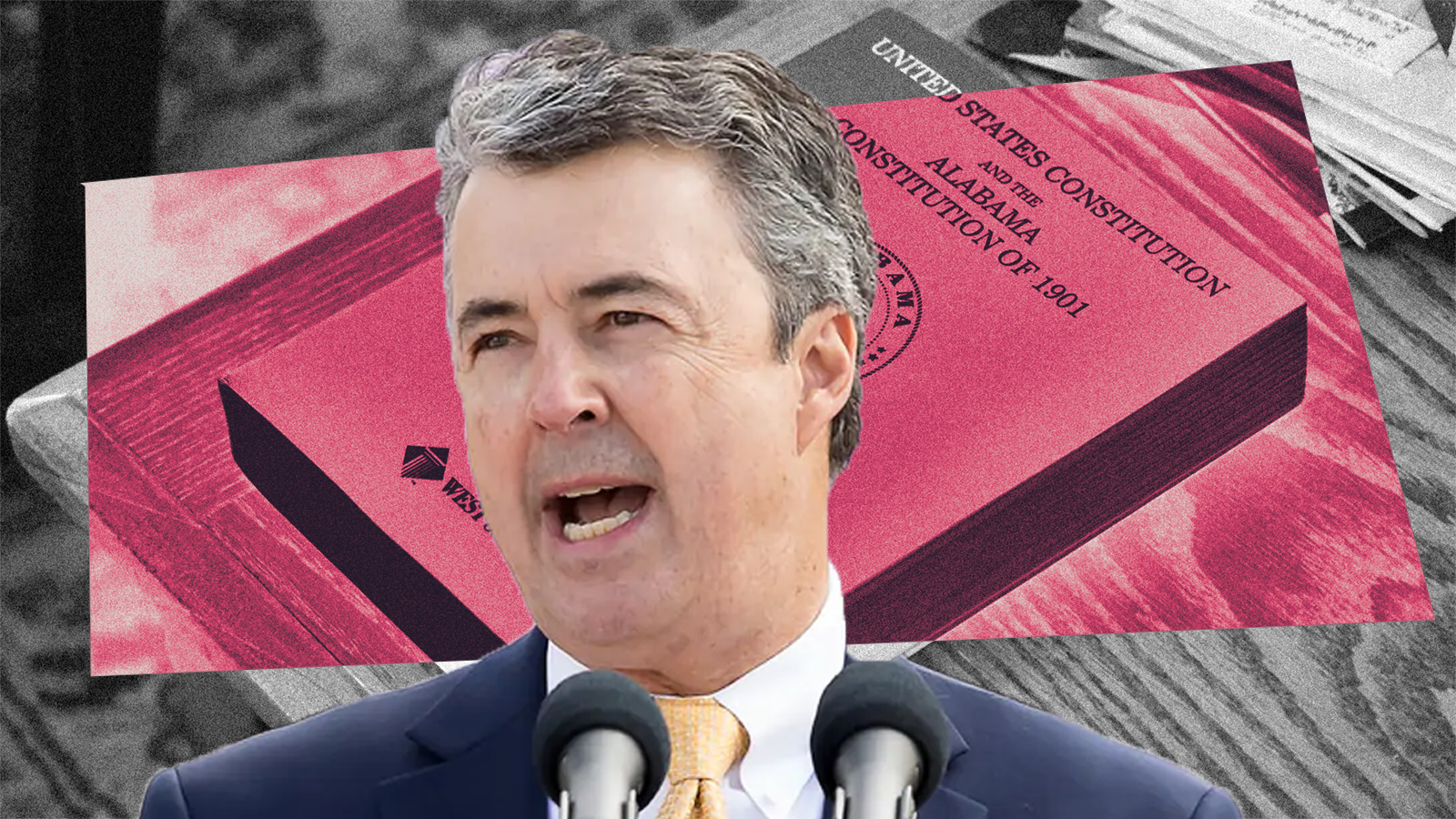
A law established by the Alabama Constitution and ratified by nearly a million Alabama voters just four years ago cannot be enforced by any court in this state.
So says the attorney general of Alabama.
You read that accurately. Steve Marshall’s office this week, in the matter of two military veterans who are challenging Tommy Tuberville’s eligibility to be the certified Republican nominee for governor of this state, has argued that no court in Alabama has the authority to enforce, or rule upon potential violations of, the statutory requirement in our constitution that a candidate for governor live in this state for the seven years preceding the general election.
The quo warranto challenge, the AG argues, is inappropriate, even though it was set up in our system as the only means for doing exactly what it’s doing in this case.
“The Supreme Court of Alabama ‘has been unequivocal in stating that elections normally do not fall within the scope of judicial review,’” the filing from Marshall’s office reads.
That filing came in defense of Alabama Secretary of State Wes Allen, who is named in the challenge in his official capacity because he is responsible for certifying the candidates and including their names on the ballots. The filing goes on to argue the point in several different ways, but all of them essentially saying the same thing:
There is no court that should be able to adjudicate this issue.
Instead, the AG’s office argues, it should be a matter left up to voters and the parties, which have their own established remedies for determining candidate eligibility.
That should bother the hell out of everyone.
Because let’s forget for a few moments that we’re talking about Tuberville and Republicans. This specific issue isn’t really about him and the situation he now finds himself in. It’s about how we enforce our laws.
There are but three requirements for a candidate for governor: 1. That he or she be at least 30 years old; 2. That he or she be a United States citizen; and 3. That he or she be a resident citizen of this state at least seven years next before the date of their election.
That’s it. Those three things haven’t changed in more than 120 years. And in 2022, when lawmakers rewrote our constitution, removing a whole bunch of racist language and reworking some portions, those three things remained. Nearly a million Alabama voters approved it.
But you’re telling me that no court has jurisdiction to enforce those three things?
What if the person who won the Democratic nomination might actually be a non-citizen?
You gonna tell me that Republicans would be OK with the Democratic Party ruling on the eligibility of the candidate?
Please.
But that’s what the AG’s office would have us believe now—that the only allowable recourses to a person possibly violating one or more of the three requirements of the office are the qualification challenge, the post-primary challenge and the post-election challenge. The first two are heard exclusively by the respective parties. The third would be heard by a joint session of the Alabama Legislature.
The first challenge in Tuberville’s case wasn’t even heard by the party. The person who filed that challenge, Ken McFeeters, said that when members of the Republican Party candidate committee entered the room to hear challenges to several different candidates, the challenges had already been separated into different stacks by the party’s attorneys. The challenge to Tuberville’s eligibility was in a pile that deemed it “facially defective,” McFeeters said, and the facts were never heard by committee members.
In the post-primary challenge held recently, ALGOP officials disregarded several of its written rules governing the challenge, including denying McFeeters the right to subpoena five witnesses and question them in depositions under oath for up two hours each and the right to issue five subpoenas for documents. Instead, on a whim, ALGOP officials decided to give McFeeters and his attorney just 40 minutes to question Tuberville.
Those are the processes our AG’s office is seriously suggesting should be utilized, instead of a court of law, to uphold our constitution.
Oh yeah, there’s also the third option—the post-election challenge, which would come after the election. That path was used in the case of former state Rep. David Cole, who used the address of a family friend in order to qualify to run in House District 10.
During the course of that challenge, Cole admitted under oath that he never spent in a night in the home he claimed as his permanent residence, never moved from his old home in another district, never had any possessions in the friend’s home, never spent much time in the home and basically fabricated a lease agreement after the fact to claim the home as his residence. All of this was on the record, under oath, and reported in various news sites at the time.
The Republican-led Alabama Legislature took those facts and responded by trying to slip language into a bill that would make it impossible to challenge a state lawmaker after they had been certified.
That’s what happens when legal decisions are left up to biased individuals.
This is what the attorney general of the state is arguing should be the proper procedure. Because that’s how far gone we are, I guess. It doesn’t matter that we’re talking about the constitution of the state. It doesn’t matter that we’re talking about a process to assure voters that candidates are eligible to hold the offices they seek. It doesn’t matter that these are basic, easy-to-understand laws that voters have repeatedly approved.
All that matters is protecting the party.