Litigants argue who decides Tuberville eligibility, and when
Tuberville’s team argues that the courts have no role in determining eligibility in the case.
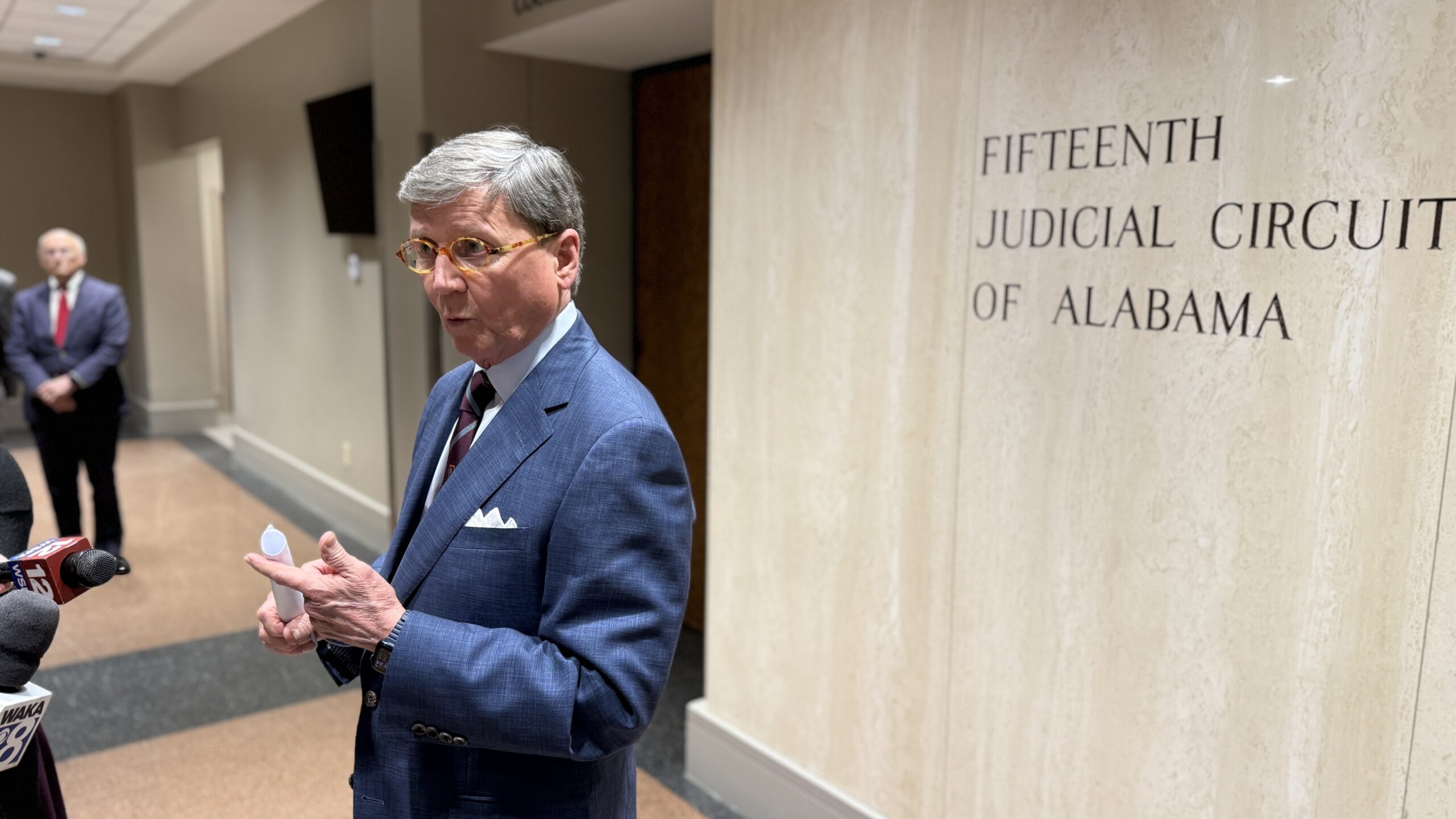
Montgomery Circuit Judge Brook Reid heard from both sides Monday afternoon on whether it is even up to the courts to decide Tommy Tuberville’s eligibility for governor.
Tuberville’s camp argued that it isn’t a matter for the courts, but for the Republican Party, the voters and then the Legislature.
“The (plaintiffs) have a mountain to climb and they’re barely on the base with nowhere to go,” Joe Espy, Tuberville’s lead attorney, told the court.
Counsel for the plaintiffs, two Alabama veterans, argued that theory flies in the face of the hundreds of years of law and that a judge should be weighing a requirement enshrined in the Alabama Constitution.
“It violates the very basis of the separation of powers,” said Barry Ragsdale, attorney for the plaintiffs. “It is the exclusive solemn purview of the Courts to interpret the Constitution. Their argument boils down to only the Republican Party gets to say what the Constitution says; it cannot be the law that one party gets to decide what the constitution is.”
That’s the basic gist of a hearing that lasted more than two hours and went into the legal weeds citing a wide span of cases which both sides agreed failed to directly address the question at hand, giving Reid limited guidance on how to rule.
“We’ve never had an out-of-stater try to run for governor before,” Ragsdale quipped during the hearing.
The major crux of the argument falls to whether a “quo warranto” case can be brought against a political nominee who does not yet actually hold public office, when that case can be brought and in what venue it should be heard.
The attorneys on both sides pointed to a large swath of case law to try and persuade Reid to their side, but none of the cases directly align with the circumstances Tuberville faces, giving each party fodder to argue that any potential application is being twisted to fit this scenario.
Tuberville’s team heavily relied on a statute that keeps courts generally from interfering in election matters; the plaintiffs’ counsel argued that the Constitution supersedes any statute if the two appear to be in conflict, while trying to point to “bread crumbs” left by the Alabama Supreme Court that point to a quo warranto challenge as the proper way to seek relief if it is believed that a candidate is ineligible to hold the office they seek.
Reid, a Democrat appointed to the circuit by Gov. Kay Ivey, emphasized her belief that the answer to the question should be found in a courtroom, which should be as apolitical as possible despite the reality that judges must identify with a political party. But she also acknowledged the difficulty of applying unclear precedent to what amounts to a “case of first impression” involving a novel legal question.
Former judge Jimmy Pool, an attorney for the plaintiffs, did not speak much during the hearing but charged that if the case was about Tuberville’s age or nationality, it would be open and shut.
“If the Democratic Party had put someone forward that was too young and we had a birth certificate, this would be done right here,” Pool said. “If they had put forward Vladimir Putin, you would say ‘you lose.’ Just because residency is a bit more murky doesn’t make it any less a question of fact—and questions of fact get decided in a court of law.”
Bill Espy, son of Joe and co-counsel for Tuberville, said that Ragsdale is going through “legal gymnastics” to try and install Doug Jones over Tuberville.
“He wants to stop the election and make Doug Jones the governor,” the younger Espy said. “So he is going through all these legal gymnastics to say he’s a ‘quasi-elected official.'”
It’s not clear how long Reid will take to come to a conclusion—she noted the urgent timing of the case but also reiterated the need to review the arguments and cases cited again before making a final ruling.
Regardless of her decision, the ruling will be immediately appealed to the Alabama Supreme Court for the final word.
The merits of the case—namely whether Tuberville has truly resided in Alabama for the past seven years—won’t come under scrutiny unless the Supreme Court rules that the case can move forward in court.
Following the hearing, Ragsdale said a trial to determine Tuberville’s residency is crucial to allow fairness for voters.
“I ask people all the time, if he’s willing to lie and misrepresent himself and violate the constitution to get into office, imagine what he’s going to do once he gets in power,” Ragsdale said. “So that’s why we think the question has to be presented to a court before the general election and let voters find out.”
Espy told the media that voters have read all about the challenges to Tuberville’s residency and it is now up to them to decide the matter.
“If they don’t think Sen. Tuberville meets the qualification, they’ll decide that,” Espy said.