U.S. Navy invests $30M in Alabama maritime workforce training
State leaders celebrated a new initiative expanding specialized curricula at four Alabama community colleges in order to boost submarine manufacturing.
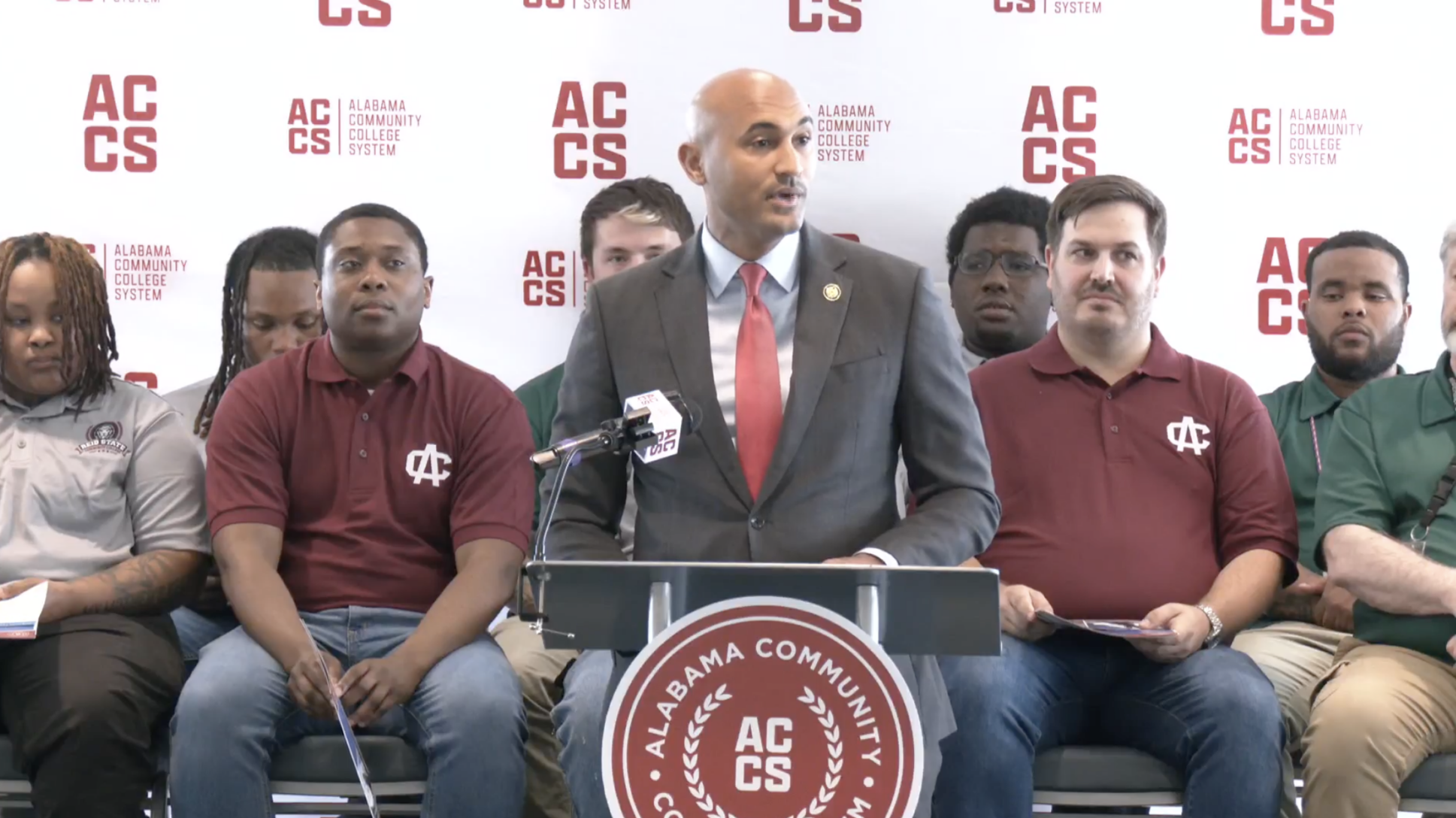
The Alabama Community College System has announced a $30 million investment funded by the U.S. Navy to expand maritime workforce training at four state community colleges.
During a press event held by ACCS on Monday morning at Mobile’s Maritime Museum of the Gulf, representatives from the Navy, community colleges, state and local governments and manufacturers celebrated the launch of the program, which aims to strengthen Alabama’s maritime workforce and submarine building capabilities.
The funds will go toward modernizing and expanding maritime workforce training at Bishop State Community College, Coastal Alabama Community College, Lurleen B. Wallace Community College’s Opp campus and Reid State Community College.
Specialized curricula to be funded by the investment include maritime welding, structural fitting and pipefitting courses at the four South Alabama community colleges. Alongside the program expansions, ACCS will also begin offering maritime training programs at each of its 24 campuses across the state.
Lindsay Cline, director of strategic partnerships for the Navy’s Submarine Industrial Base, opened the event by emphasizing the importance of the Navy’s collaborations with maritime industries in Mobile.
“Right across the water from where we sit and stand today, almost 350 extraordinarily talented, skilled-tradespeople and engineers are working diligently to build our nation’s most survivable and critical component of strategic nuclear deterrents—submarines,” Cline said.
“Over the course of the next decade, the maritime workforce demand in this state is expected to grow by over 10,000 people—pipe welders, pipe fitters, ship fitters, structural welders, electricians, engineers, industrial maintenance professionals and the list goes on,” she added. “But I want to be very clear today. We are not here just to train skilled-trades professionals. We are here to train maritime experts.”
The Navy has projected that 250,000 new skilled workers will be needed in maritime manufacturing nationwide over the next decade.
U.S. Representative Shomari Figures, D-Ala., celebrated the initiative’s launch during the press conference, which he said displays his district and the state’s emergence as a vital manufacturing hub.
“The secret is out about Mobile and about Alabama. This is becoming a manufacturing hub that is recognized across this country,” Figures said. “If you need airplanes, we can build them. You need ships; we can build them. You need stainless steel; we can make it. You need cars; we can make it. And going forward today, we need submarines. We can make those too. And we knew the world needed Mardi Gras, so we made that.”
Mobile Mayor Spiro Cheriogotis similarly championed the significance of the investment to the future of industry in his city.
“What makes this moment special is what this kind of investment says about Mobilians,” the mayor said.
“Because of our workforce and investment from companies like Austal and Airbus, the most advanced machines in the sky, and on the water are already being built right here in Mobile,” Cheriogotis continued. “And now, with the support of the U.S. Navy, we’ll be preparing future workers to build the best submarines beneath those waves as well. I believe that’s truly a testament to the talent of our local workforce.”
Bishop State Community College President Dr. Oliver Charles highlighted that, in the Mobile region, the average need for employees in the maritime industry is roughly 7,300 people, double the national average.
“To add onto that, our nation has set an ambitious goal. By 2028, we must produce one Columbia Class Submarine and two Virginia Class Submarines per year,” said Charles. “That is a five-fold increase from what we are doing today, and I want to be clear, this isn’t just a workforce issue, it is a national security issue.”
“With the Navy’s $30 million investment into Alabama’s community colleges, we’re taking a bold and concerted effort to build our nation’s workforce pipeline, specifically toward maritime, and more specifically around submarine construction,” he added. “Together we’re advancing opportunities. We’re modernizing facilities, and we’re aligning our programs to meet the real needs of the industry.”
Alabama Secretary of Labor Greg Reed described the Navy’s investment as Alabama taking greater responsibility for national defense.
“The announcement today will grow Alabama’s economy. But not just grow Alabama’s economy,” he said. “This will secure a new age of Alabama’s place in securing America.”
“Shipbuilding is about more than steel and more than systems; it’s about people. Welders, fitters, electricians, and technicians who meet the highest standards of quality and safety,” said Eugene Miller, interim president of Austal USA, Mobile’s largest shipbuilding company.
“These skills must be taught, practiced and perfected, and that starts in our classrooms and training labs. This partnership is essential, not just for Austal USA, but also for the U.S. Navy, the Coast Guard and international security,” he continued.
ACCS Chancellor Jimmy Baker, Bradley Byrne and former ACCS chancellor and CEO of the Mobile Chamber of Commerce also gave remarks celebrating the Navy’s investment.
Monday’s event comes a week after the ribbon-cutting event for a $2.4 billion submarine plant in Cherokee.
Austal USA has also recently broken ground on multiple efforts to expand its ship and submarine building capacities.
This includes the company’s Modular Manufacturing Facility 3, a Mobile structure that will allow the company to expand its modular ship and submarine building capabilities and the construction and launch complex, Final Assembly 2. Austal USA reports that the facilities make up a combined $750 million investment.